
Syncra
Syncra
Reducing workflow publishing failures through proactive policy validation.
Reducing workflow publishing failures through proactive policy validation.
Helping managers publish workflows successfully on the first attempt by surfacing policy constraints earlier in the workflow creation process.
Helping managers publish workflows successfully on the first attempt by surfacing policy constraints earlier in the workflow creation process.
Context
Context
Product design challenge
Product design challenge
Role
Role
Responsible for research, problem analysis, idea concept, and sketching.
Responsible for research, problem analysis, idea concept, and sketching.
Timeline
Timeline
3 weeks
3 weeks
01 - BACKGROUND
01 - BACKGROUND
The background is…
The background is…
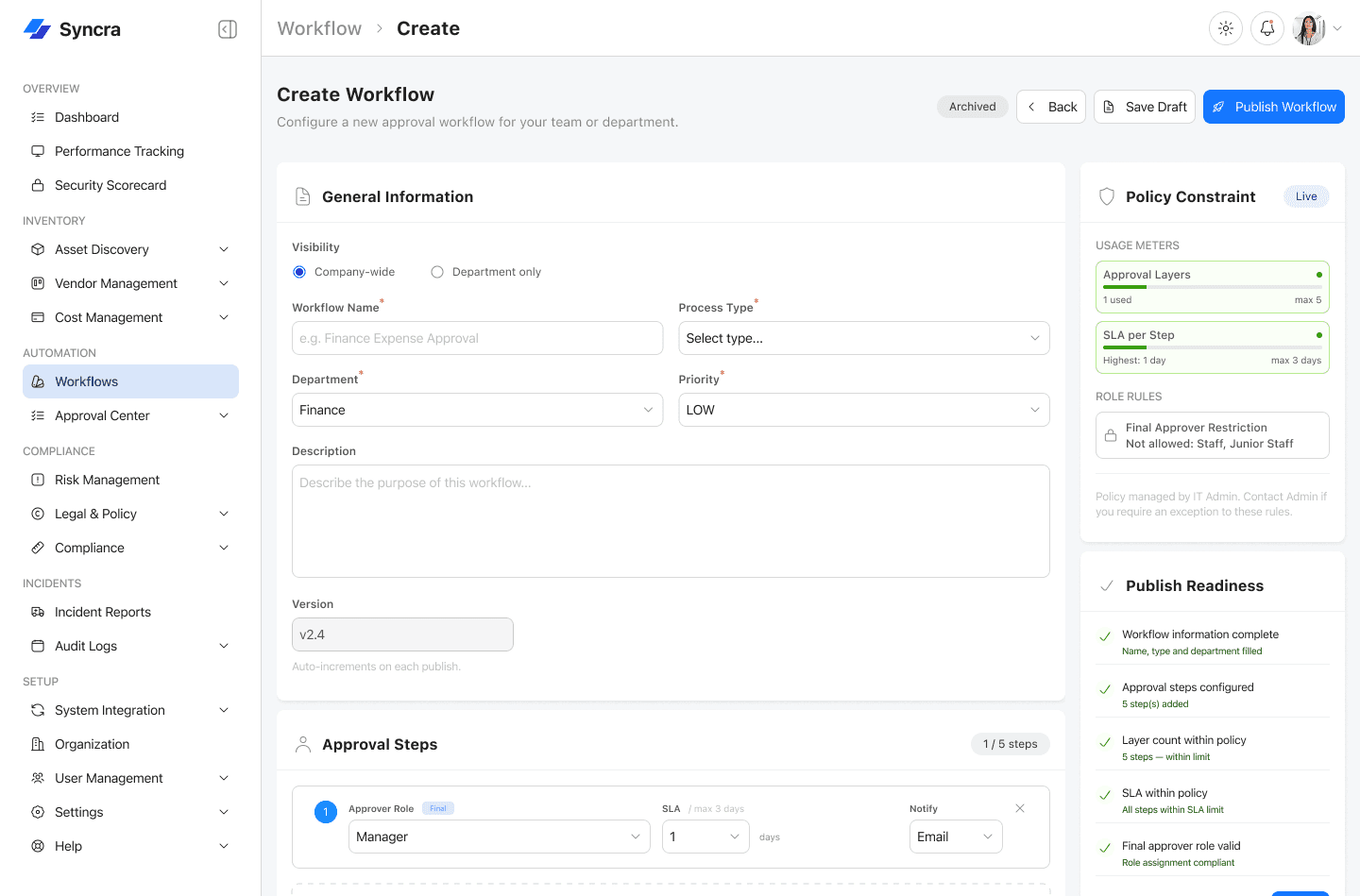
Syncra is an internal platform that allows managers to create approval workflows for operational processes such as expenses, leave request, procurement, and promotions. Each workflow must comply with company-specific approval policies. These policies define rules such as required approvers, approval hierarchy, and department-specific restrictions.
Currently, policy validation only occurs during the final publishing step. As a result, managers often discover policy violations only after completing the entire configuration process. The late feedback creates friction in the workflow creation experience and frequently prevents managers from successfully publishing their workflows.
Syncra is an internal platform used by managers to create approval workflows for requests such as expenses, leave, procurement, and promotions. To ensure compliance with company policy, each workflow must follow specific approval rules. However, workflow publishing failures frequently occur, suggesting friction in the current creation process.
Syncra is an internal platform that allows managers to create approval workflows for operational processes such as expenses, leave request, procurement, and promotions. Each workflow must comply with company-specific approval policies. These policies define rules such as required approvers, approval hierarchy, and department-specific restrictions.
Currently, policy validation only occurs during the final publishing step. As a result, managers often discover policy violations only after completing the entire configuration process. The late feedback creates friction in the workflow creation experience and frequently prevents managers from successfully publishing their workflows.
The objective is to
The objective is to
Surface policy constraints earlier during workflow configuration instead of only at the publishing stage.
Reduce workflow publishing failures caused by late discovery of policy violations.
Minimize rework by enabling managers to detect and resolve violations while building the workflow.
Syncra is an internal platform used by managers to create approval workflows for requests such as expenses, leave, procurement, and promotions. To ensure compliance with company policy, each workflow must follow specific approval rules. However, workflow publishing failures frequently occur, suggesting friction in the current creation process.
Actors
Actors
Behind the interface, the workflow builder connects multiple actors and systems to enforce company approval policies.
Behind the interface, the workflow builder connects multiple actors and systems to enforce company approval policies.
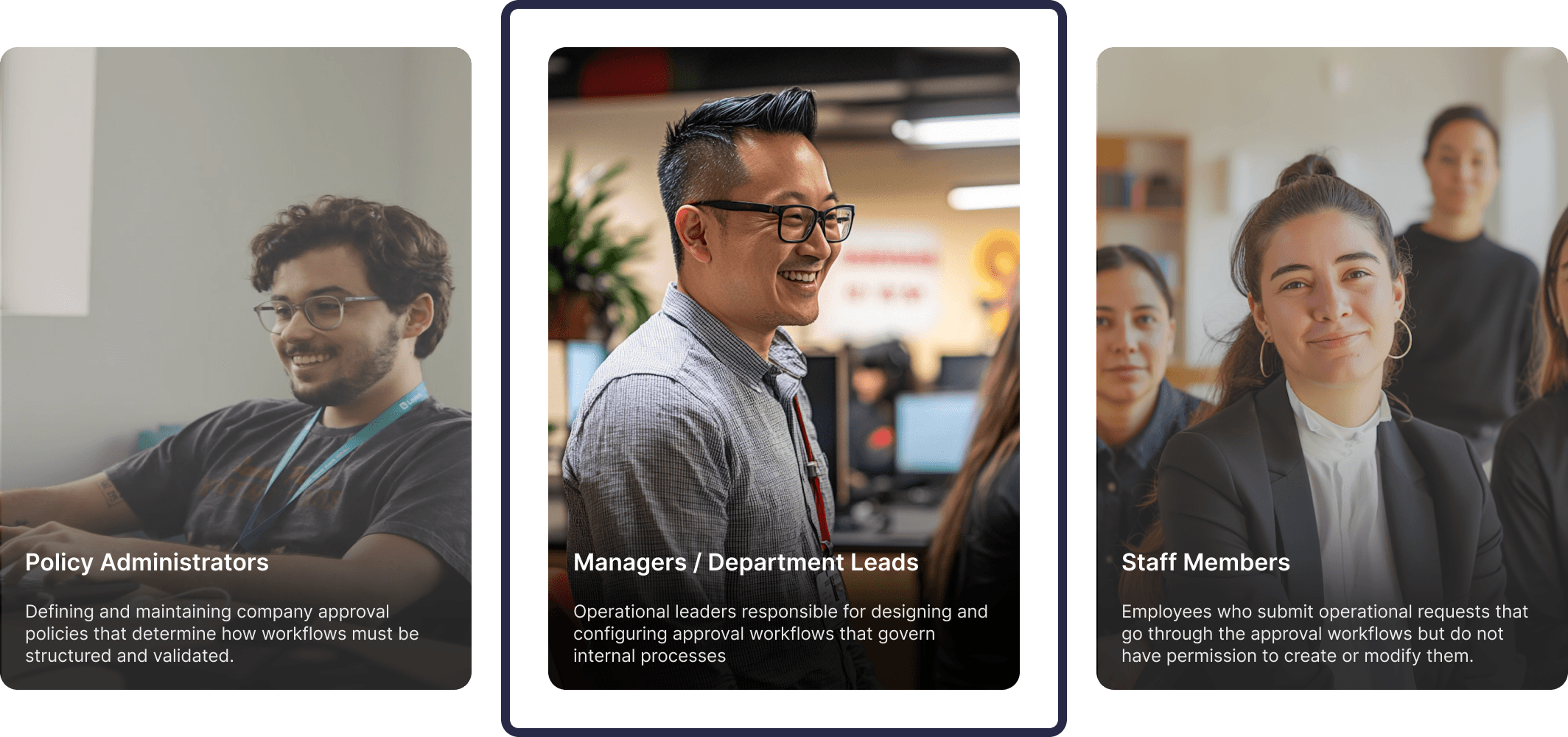
Since workflow configuration is performed by managers, the design challenge primarily focuses on improving their workflow creation experience.
Since workflow configuration is performed by managers, the design challenge primarily focuses on improving their workflow creation experience.
System map
System map
Once managers configure a workflow in Syncra, the system evaluates the configuration against organizational approval policies. These policies are enforced through a centralized policy engine that validates whether the workflow structure complies with company rules. If the configuration passes validation, the workflow can be published and used by operational systems to process requests such as expenses, procurement, or promotions.
The diagram below illustrates how managers, the workflow builder, and policy enforcement interact within the workflow ecosystem.
Once managers configure a workflow in Syncra, the system evaluates the configuration against organizational approval policies. These policies are enforced through a centralized policy engine that validates whether the workflow structure complies with company rules. If the configuration passes validation, the workflow can be published and used by operational systems to process requests such as expenses, procurement, or promotions.
The diagram below illustrates how managers, the workflow builder, and policy enforcement interact within the workflow ecosystem.

System map diagram
System map diagram
02 - PROBLEM DEFINITION
02 - PROBLEM DEFINITION
The issues…
The issues…
I analyzed potential causes behind workflow publishing failures. Through affinity mapping, several patterns emerged that explain why managers struggle to successfully publish workflows.
I analyzed potential causes behind workflow publishing failures. Through affinity mapping, several patterns emerged that explain why managers struggle to successfully publish workflows.
Late visibility of policy constraints
Late visibility of policy constraints
Managers complete the entire workflow configuration before discovering policy violations.
Managers complete the entire workflow configuration before discovering policy violations.
Delayed feedback
Delayed feedback
Because validation only happens at the end of the process, users receive feedback after investing significant effort.
Because validation only happens at the end of the process, users receive feedback after investing significant effort.
Error fatigue
Error fatigue
After encountering validation errors, many users prefer abandoning the workflow rather than correcting it.
After encountering validation errors, many users prefer abandoning the workflow rather than correcting it.
In addition, policy rules vary between departments and frequently change based on company policies. Without clear visibility into these constraints during configuration, managers often rely on memory or outdated documentation. As a result, policy violations are frequently discovered only when attempting to publish the workflow.
In addition, policy rules vary between departments and frequently change based on company policies. Without clear visibility into these constraints during configuration, managers often rely on memory or outdated documentation. As a result, policy violations are frequently discovered only when attempting to publish the workflow.
Data shows that…
Data shows that…
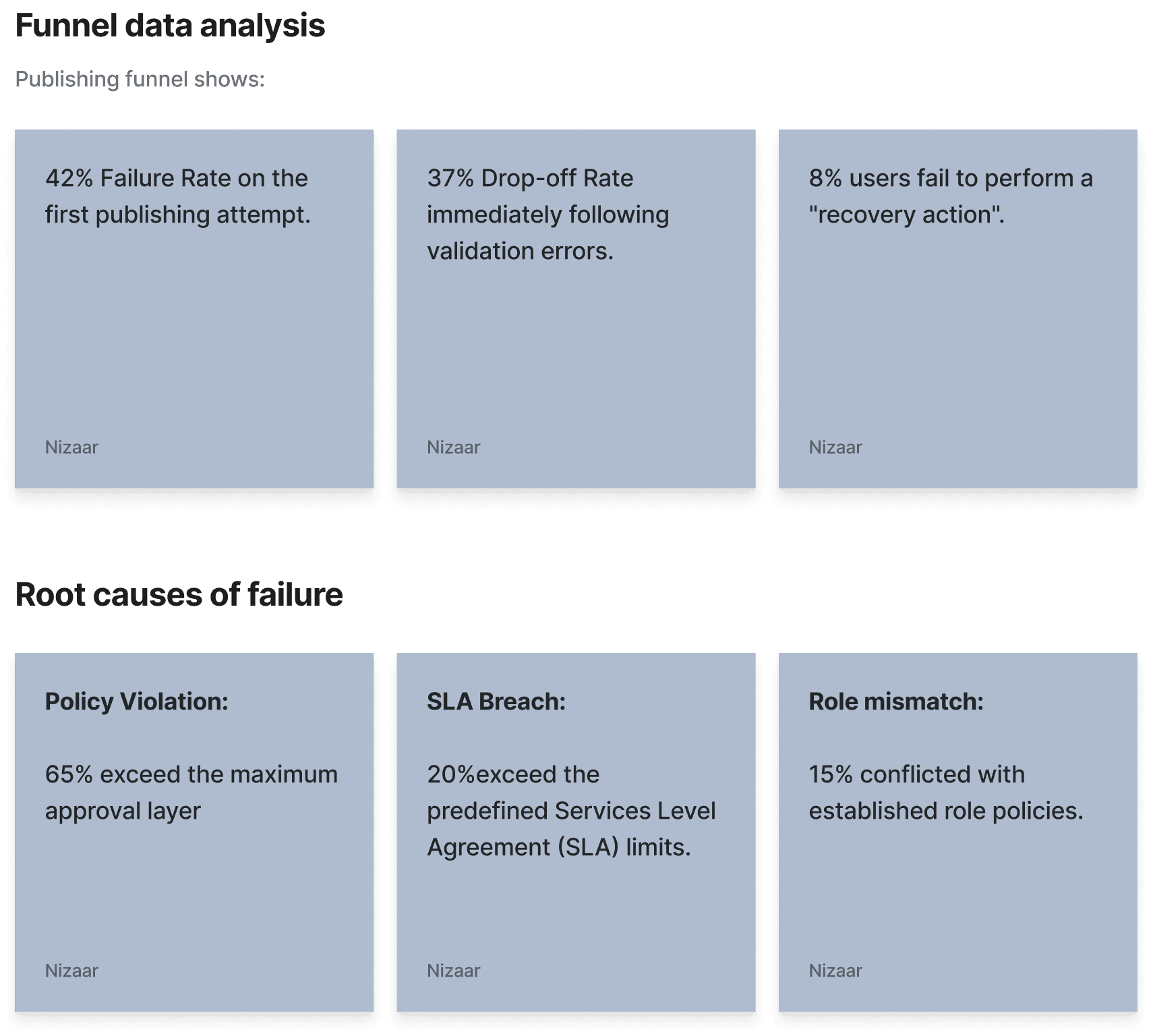
Analysis of the workflow creation funnel indicates that the highest friction occurs at the publishing stage, where strict policy validation intersects with the highest level of user effort.
Analysis of the workflow creation funnel indicates that the highest friction occurs at the publishing stage, where strict policy validation intersects with the highest level of user effort.
They say..
They say..
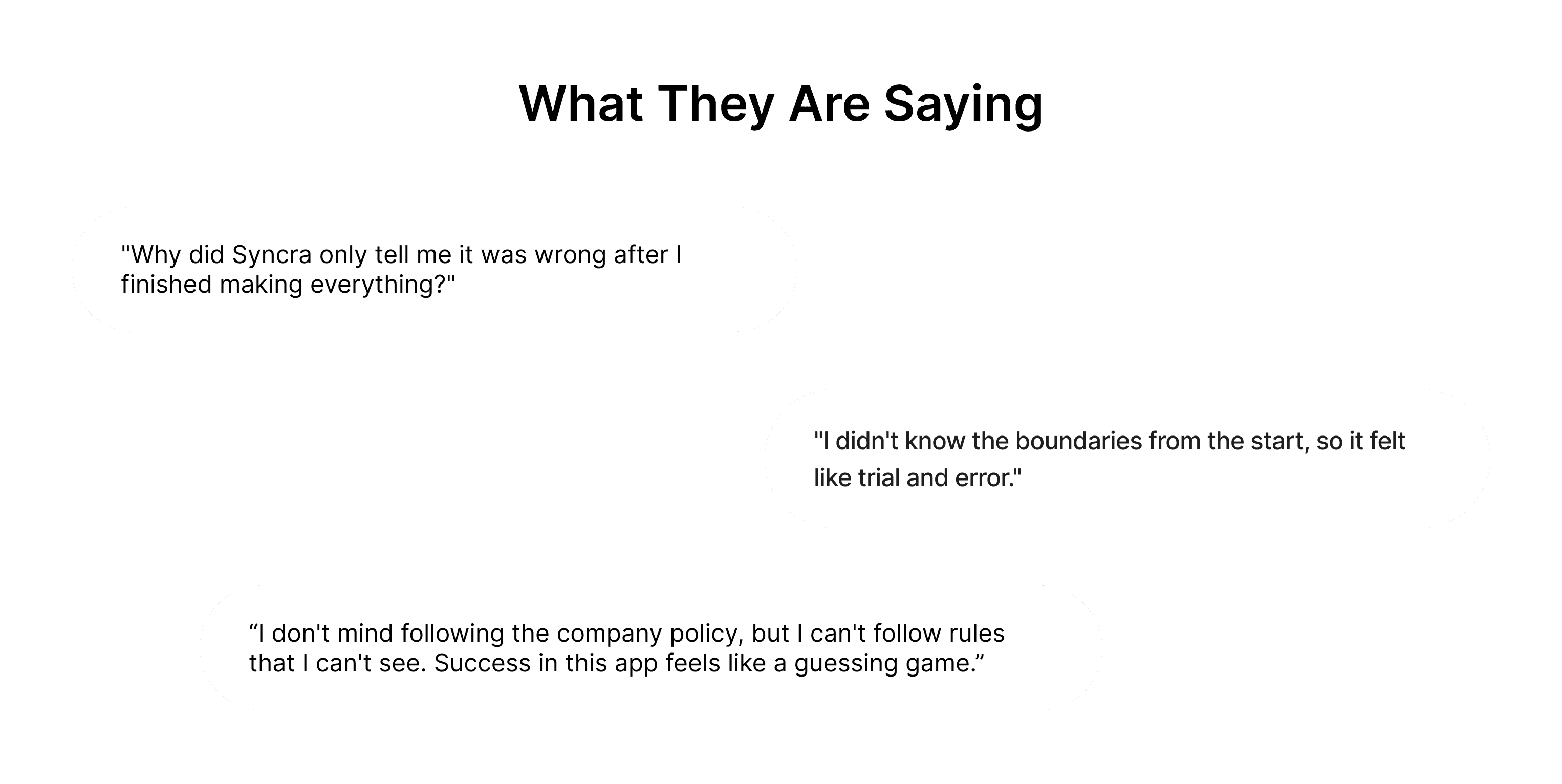
Insights derived from the challenge brief and stakeholder perspectives highlight common frustrations experienced by managers during workflow creation.
Insights derived from the challenge brief and stakeholder perspectives highlight common frustrations experienced by managers during workflow creation.
Constraint
Constraint
Design decisions were made within existing business and technical limitations.
Design decisions were made within existing business and technical limitations.
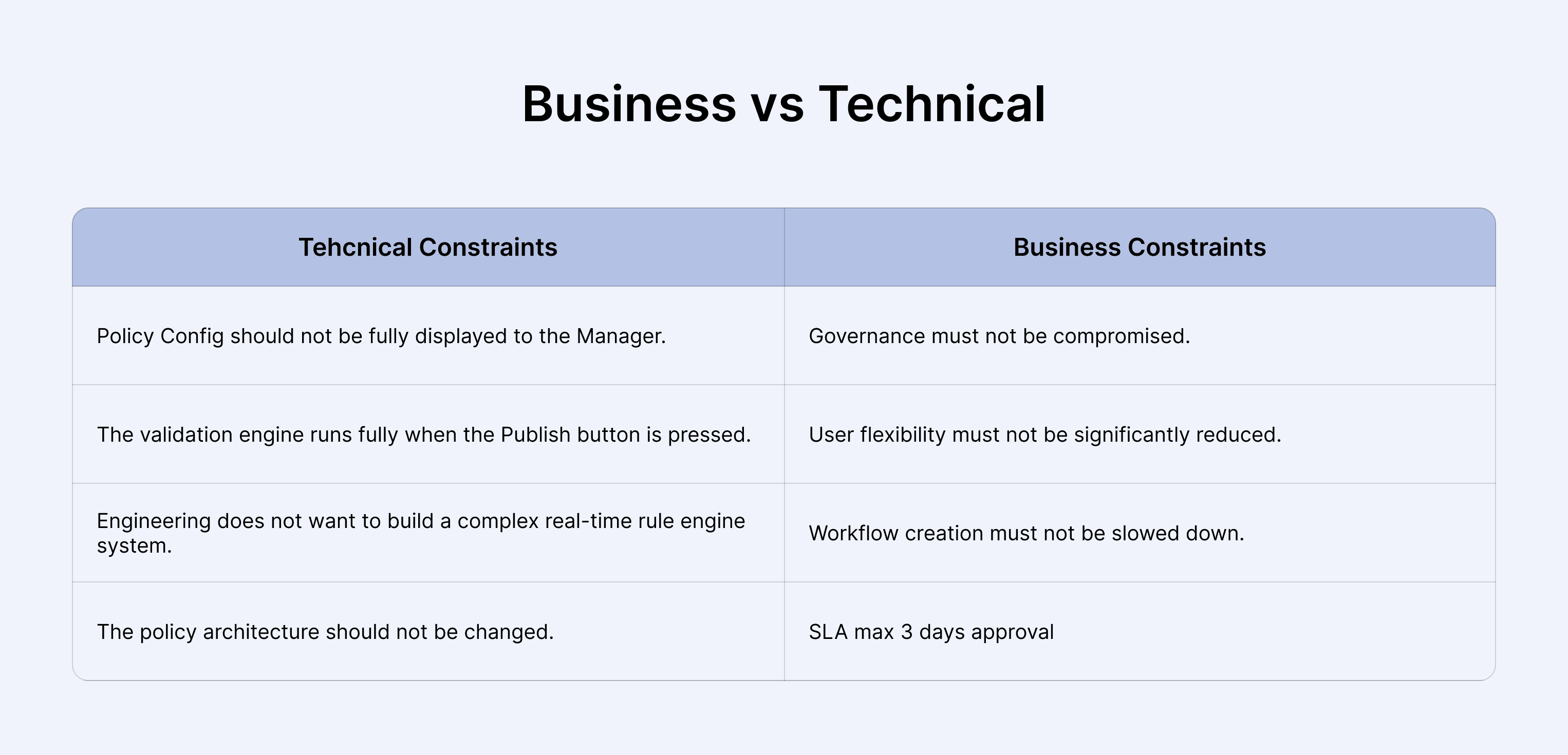
These constraints guided the design toward solutions that improve constraint visibility without modifying the underlying policy engine.
These constraints guided the design toward solutions that improve constraint visibility without modifying the underlying policy engine.
PROBLEM STATEMENT
PROBLEM STATEMENT
How might we help managers detect policy violations earlier so they can successfully publish workflows on the first attempt?
How might we enable managers to adequately build compliant workflows & increase their visibility of the policy constraints?
How might we help managers detect policy violations earlier so they can successfully publish workflows on the first attempt?
03 - GOAL DEFINITION
03 - GOAL DEFINITION
Settings the project goals…
Settings the project goals…
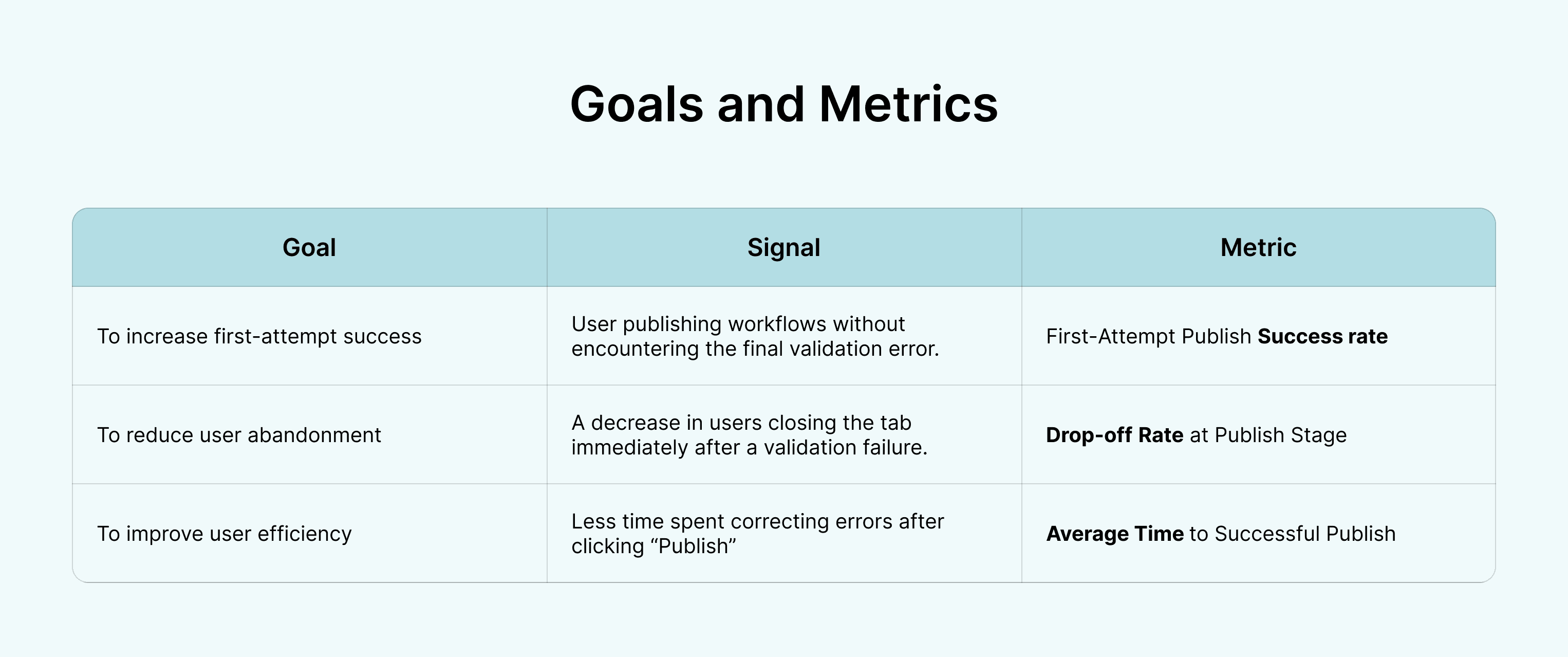
The goal of this project is to transform the workflow creation process from trial-and-error into a guided workflow building experience. By aligning policy constraints with the user's creation flow, the design aims to reduce late-stage errors and improve publishing success.
To evaluate success, the following framework was defined:
The goal of this project is to transform the workflow creation process from trial-and-error into a guided workflow building experience. By aligning policy constraints with the user's creation flow, the design aims to reduce late-stage errors and improve publishing success.
To evaluate success, the following framework was defined:
04 - IDEATION
04 - IDEATION
What Syncra has done…
What Syncra has done…
Several solutions were previously introduced to address publishing failures, but they did not significantly improve the experience.
Several solutions were previously introduced to address publishing failures, but they did not significantly improve the experience.
Detailed error messages
Validation errors were displayed during publishing, but users still encountered them only after completing the workflow configuration.Tooltips explaining policy rules
Although tooltips provided additional guidance, they were rarely read during the configuration process.Links to policy documentation
External documentation was available, but most users did not leave the workflow builder to review policy details.
Detailed error messages
Validation errors were displayed during publishing, but users still encountered them only after completing the workflow configuration.Tooltips explaining policy rules
Although tooltips provided additional guidance, they were rarely read during the configuration process.Links to policy documentation
External documentation was available, but most users did not leave the workflow builder to review policy details.
Overall, these approaches relied on passive guidance, requiring users to actively search for constraints rather than receiving them during workflow creation.
Overall, these approaches relied on passive guidance, requiring users to actively search for constraints rather than receiving them during workflow creation.
Cooking up the Concepts
Cooking up the Concepts
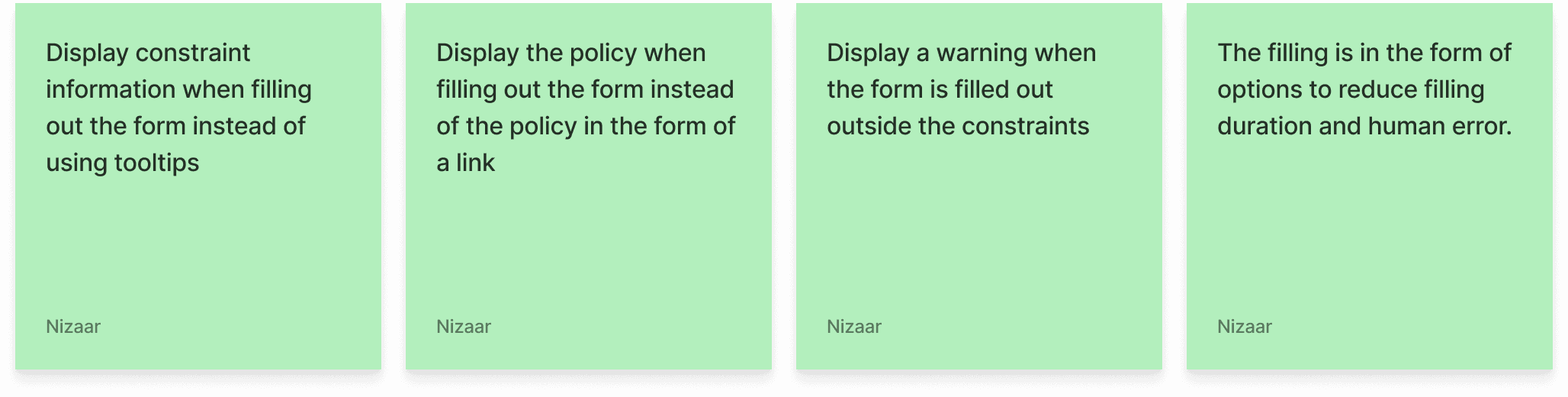
To address these limitations, I explored different interaction models that could better integrate policy constraints into the workflow creation process.
To address these limitations, I explored different interaction models that could better integrate policy constraints into the workflow creation process.
PROPOSED SOLUTION
PROPOSED SOLUTION
A proactive guidance system that surfaces policy constraints during workflow creation, enabling managers to build workflows in an integrated workspace with real-time validation and contextual guidance so violations are identified during configuration rather than at publishing.
A proactive guidance system that surfaces policy constraints during workflow creation, enabling managers to build workflows in an integrated workspace with real-time validation and contextual guidance so violations are identified during configuration rather than at publishing.
Business Goal
Business Goal
Reducing invalid workflows lowers operational overhead for policy administrators by minimizing manual reviews and configuration fixes.
Reducing invalid workflows lowers operational overhead for policy administrators by minimizing manual reviews and configuration fixes.
Key Success Factor
Key Success Factor
The goal is zero error workflow publishing, achieved by introducing automated guardrails that prevent policy violations before the publishing stage.
The goal is zero error workflow publishing, achieved by introducing automated guardrails that prevent policy violations before the publishing stage.
The key design principle was shifting the system from reactive validation to proactive guidance.
The key design principle was shifting the system from reactive validation to proactive guidance.
05 - SOLUTION
05 - SOLUTION
Restructuring the workflow builder…
Restructuring the workflow builder…
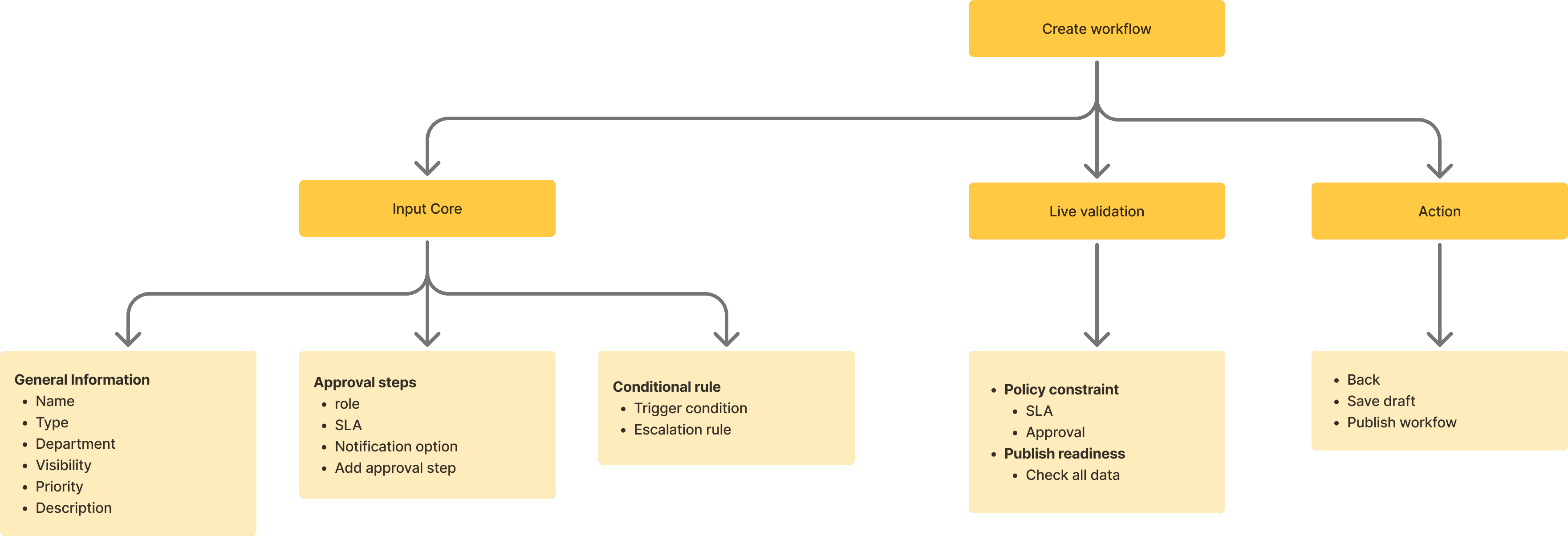
To support proactive guidance, the workflow builder needed a structure that integrates policy validation directly into the creation flow. Instead of separating configuration and validation stages, the new architecture embeds validation checkpoints throughout the workflow setup process. This structure allows the to evaluate constraints progressively as managers configure approval steps.
To support proactive guidance, the workflow builder needed a structure that integrates policy validation directly into the creation flow. Instead of separating configuration and validation stages, the new architecture embeds validation checkpoints throughout the workflow setup process. This structure allows the to evaluate constraints progressively as managers configure approval steps.
Information Architecture
Information Architecture
Time to explore…
Time to explore…
Wireframe
Wireframe
Several interaction approaches were explored to determine how policy constraints could be integrated into the workflow creation process.
Several interaction approaches were explored to determine how policy constraints could be integrated into the workflow creation process.
The sketches focused on testing different ways to:
Display validation feedback during configuration
Guide managers through compliant approval structures
Minimize interruptions while building workflows
The sketches focused on testing different ways to:
Display validation feedback during configuration
Guide managers through compliant approval structures
Minimize interruptions while building workflows
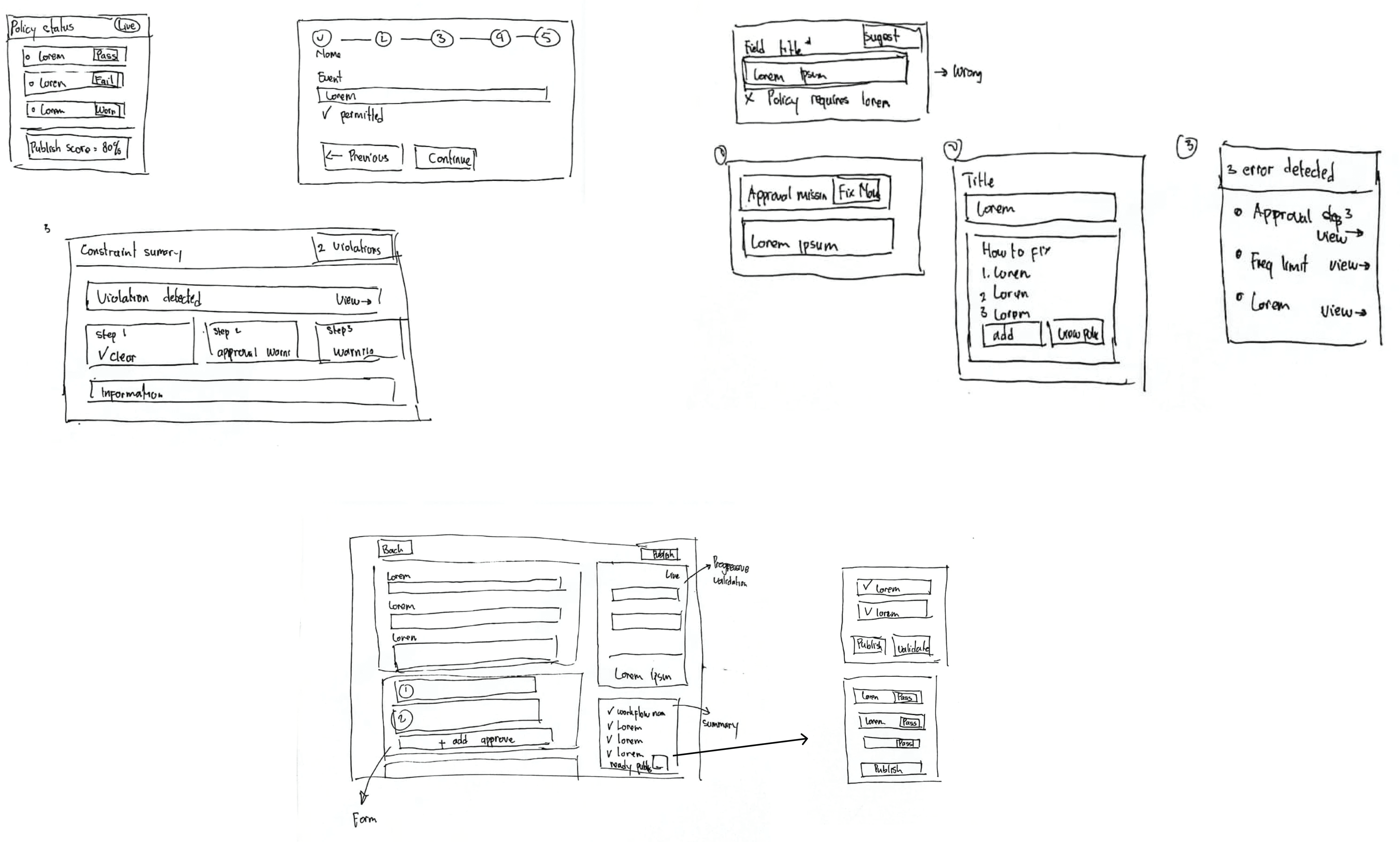
Wireframe
Wireframe
These early sketches helped refine the interaction model before moving into high-fidelity designs.
These early sketches helped refine the interaction model before moving into high-fidelity designs.
Design Sytem
Design Sytem
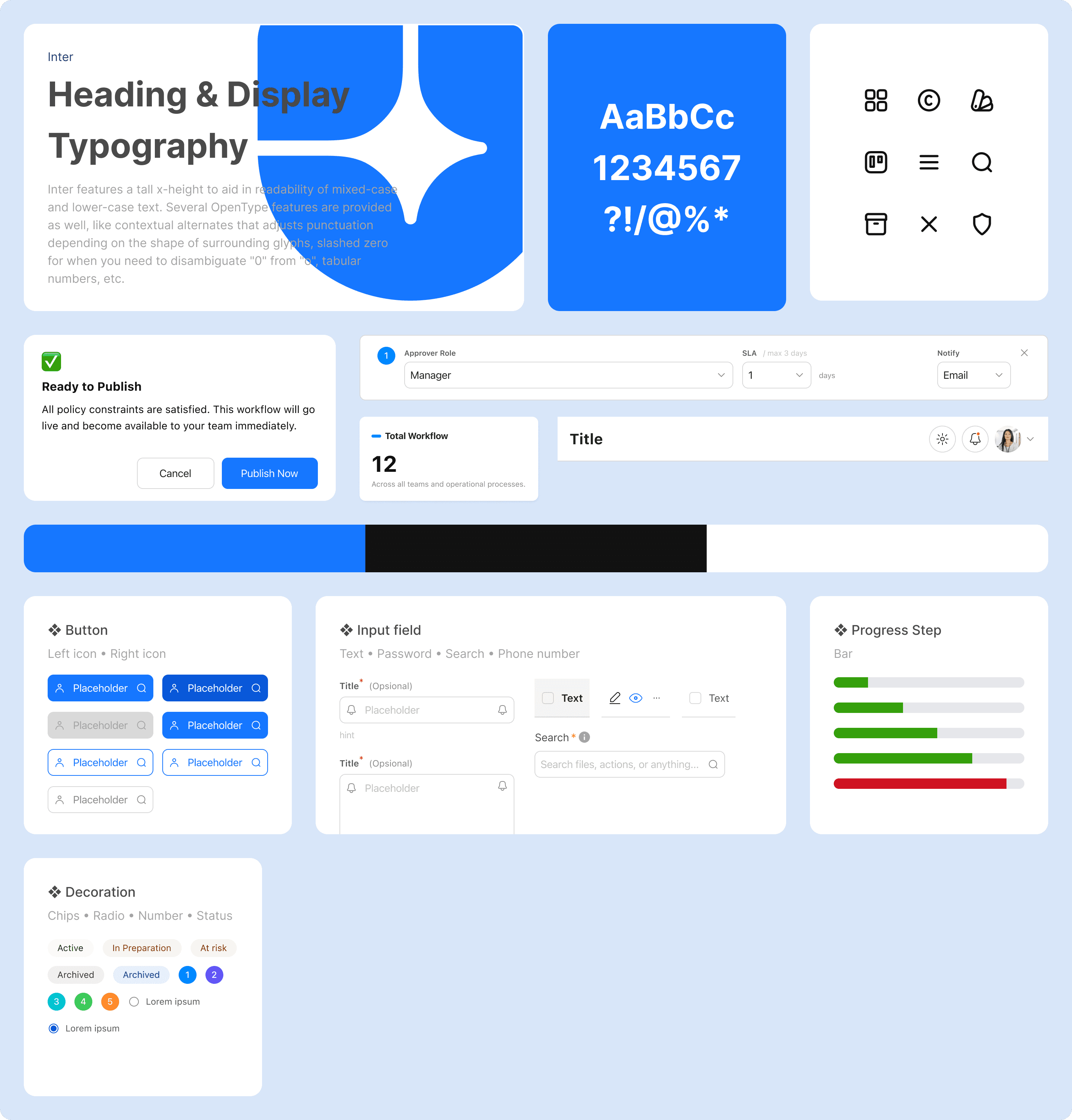
To keep everything consistent and easy to use across the whole platform, I created this design system. It serves as a single source of truth, making sure that every button, color, and font stays the same no matter where the user is.
To keep everything consistent and easy to use across the whole platform, I created this design system. It serves as a single source of truth, making sure that every button, color, and font stays the same no matter where the user is.
Let's Design…
Let's Design…
Part 1 - Increasing first-attempt publish success
Part 1 - Increasing first-attempt publish success
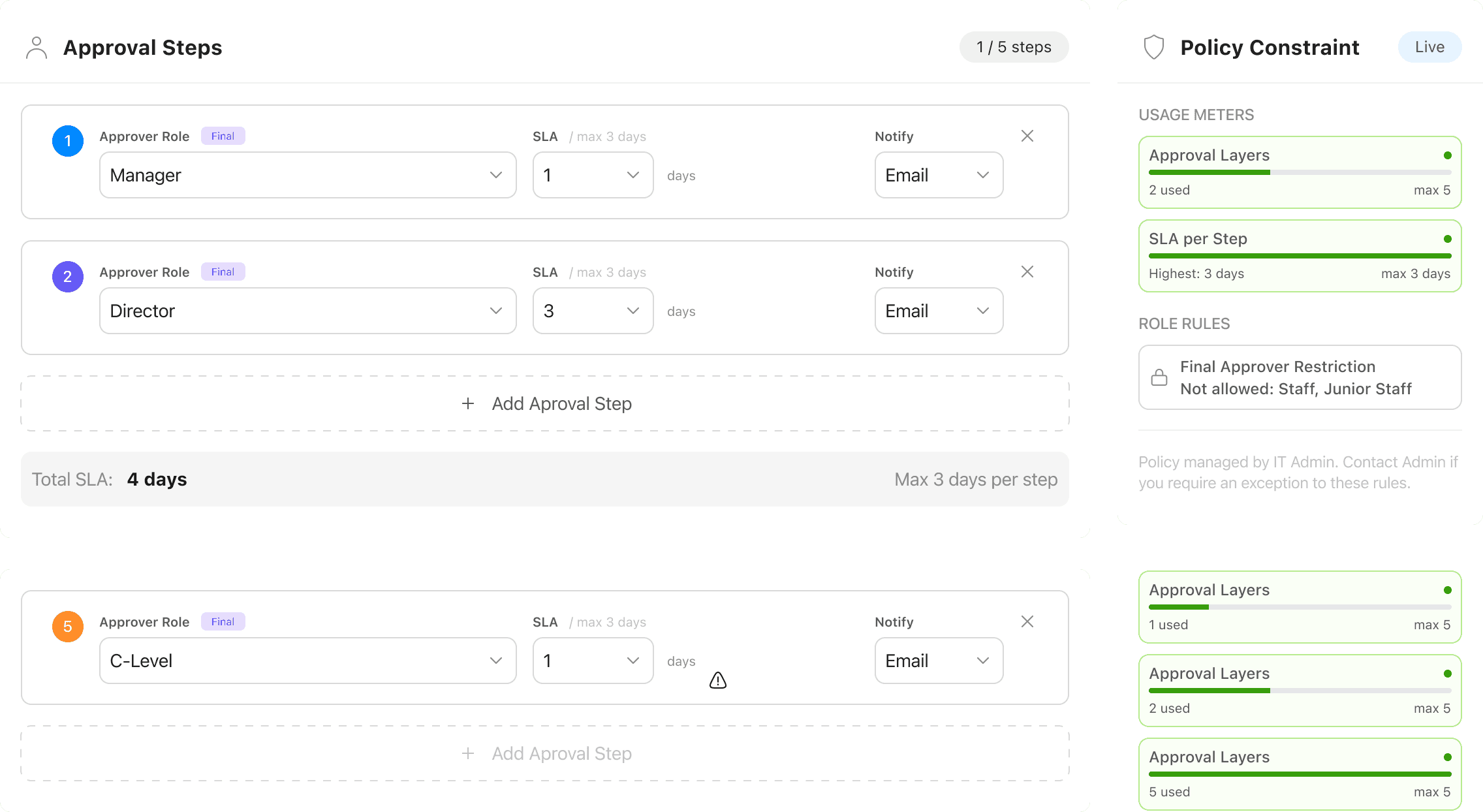
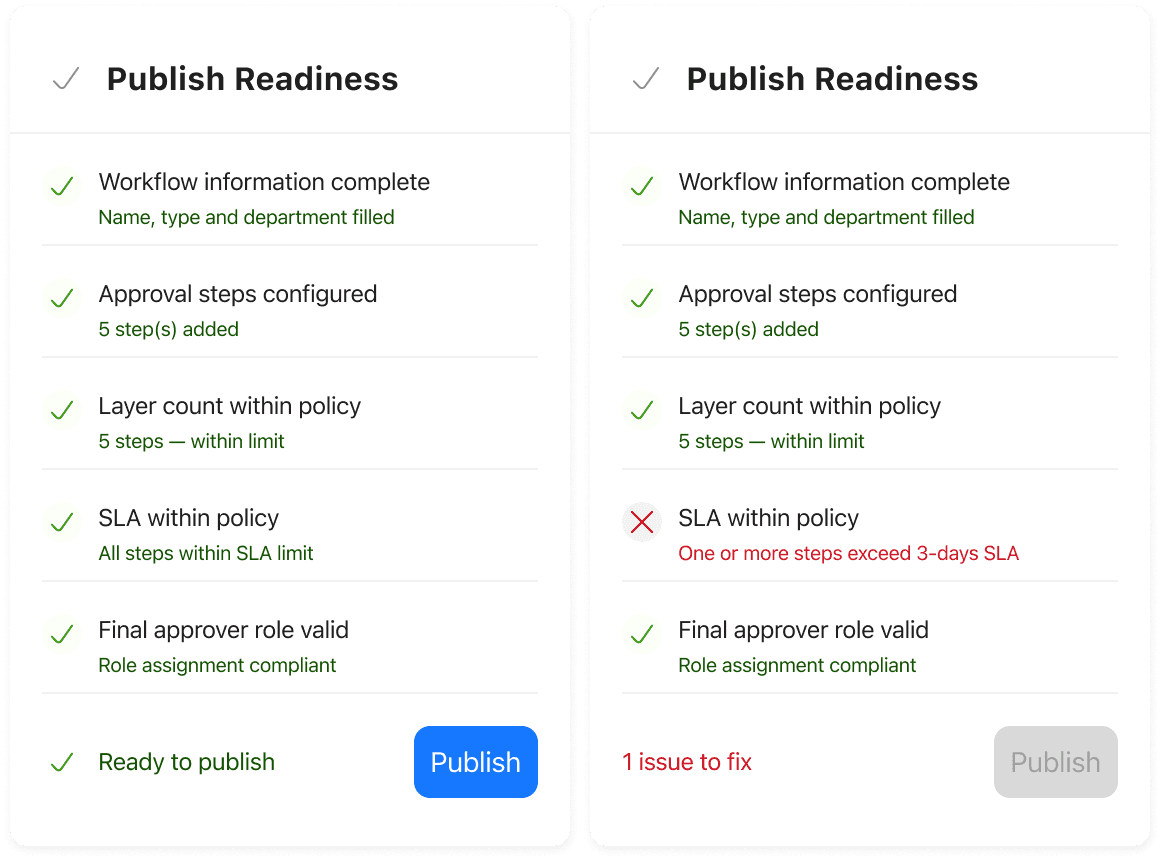
Because policy violations previously appeared only during the final publishing step, the new design introduces progressive validation during workflow configuration. When a configuration violates a policy rule, the system immediately highlights the affected step and displays an inline validation message explaining the issue and how to resolve it. This allows managers to detect and correct violations earlier in the process
Because policy violations previously appeared only during the final publishing step, the new design introduces progressive validation during workflow configuration. When a configuration violates a policy rule, the system immediately highlights the affected step and displays an inline validation message explaining the issue and how to resolve it. This allows managers to detect and correct violations earlier in the process
Part 2 - Reducing workflow abandonment
Part 2 - Reducing workflow abandonment
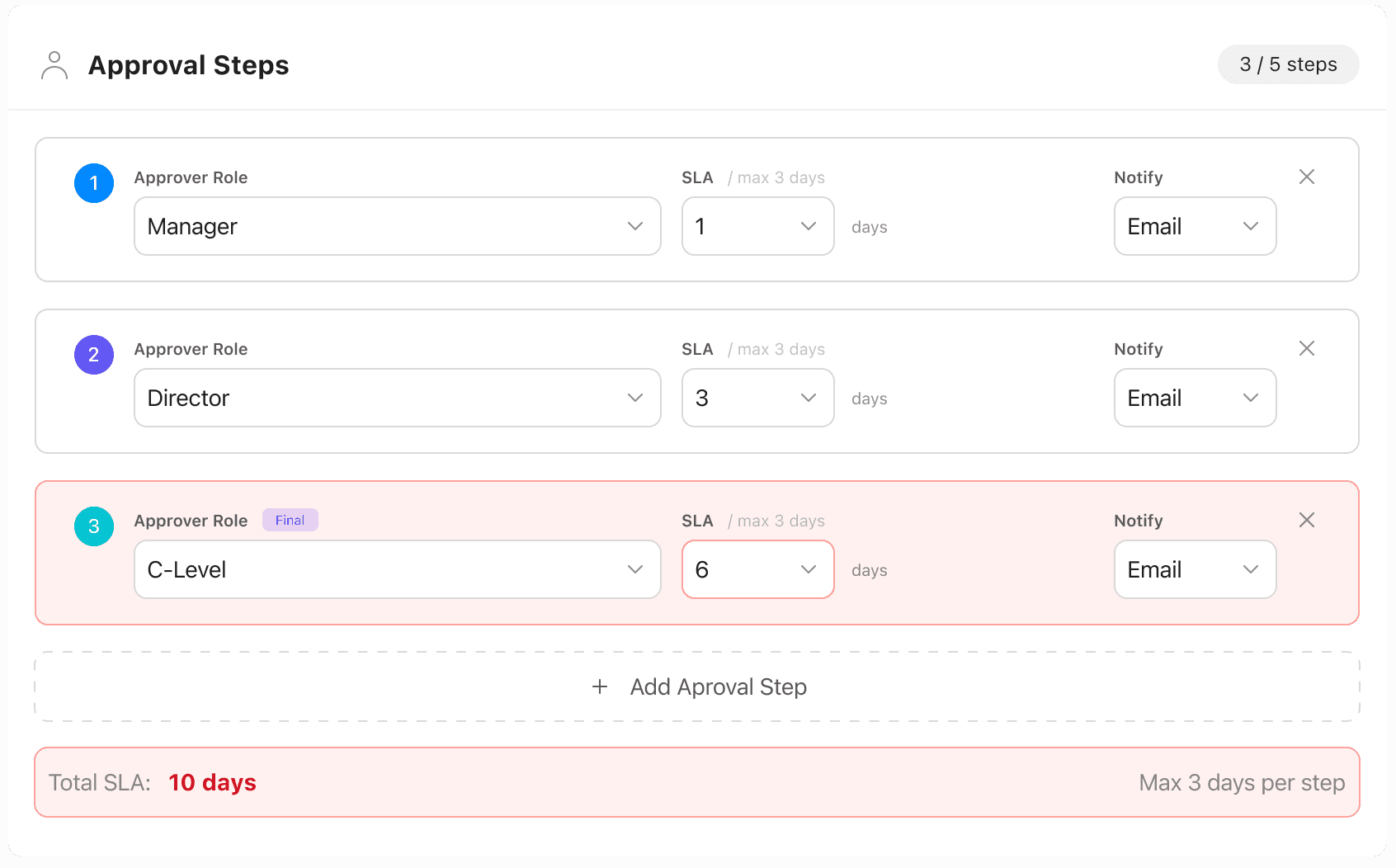
Previously, encountering multiple validation errors often caused users to abandon their workflow configuration. To improve error recovery, validation feedback is now localized and actionable. Inline error messages highlight exactly where the issue occurs and provide clear guidance on how to resolve it, allowing users to correct problems without restarting the workflow configuration.
Previously, encountering multiple validation errors often caused users to abandon their workflow configuration. To improve error recovery, validation feedback is now localized and actionable. Inline error messages highlight exactly where the issue occurs and provide clear guidance on how to resolve it, allowing users to correct problems without restarting the workflow configuration.
Part 3 - Improving workflow creation efficiency
Part 3 - Improving workflow creation efficiency
Managers often spend significant time troubleshooting validation errors during publishing. To reduce this inefficiency, the interface introduces contextual guidance during configuration. Relevant policy hints and approval structure suggestions help managers understand constraints while building workflows. This reduces the need for trial-and-error corrections later in the process.
Managers often spend significant time troubleshooting validation errors during publishing. To reduce this inefficiency, the interface introduces contextual guidance during configuration. Relevant policy hints and approval structure suggestions help managers understand constraints while building workflows. This reduces the need for trial-and-error corrections later in the process.
06 - Expected Impact
06 - Expected Impact
How the solution addresses the defined success metrics
How the solution addresses the defined success metrics
Increase first-attempt publish success
Real-time validation helps users detect violations earlier, reducing errors during publishing.Reduce workflow abandonment
Inline feedback allows users to correct issues immediately without restarting the workflow.Improve efficiency
Contextual guidance helps managers understand policy constraints while building workflow, reducing time spent troubleshooting errors.
Increase first-attempt publish success
Real-time validation helps users detect violations earlier, reducing errors during publishing.Reduce workflow abandonment
Inline feedback allows users to correct issues immediately without restarting the workflow.Improve efficiency
Contextual guidance helps managers understand policy constraints while building workflow, reducing time spent troubleshooting errors.
Trade-offs
Early validation vs interface clutter
Showing too many constraints could overwhelm users. To balance this, validation cues were designed to appear only when relevant.Automation vs user control
Automatically enforcing approval structures could reduce flexibility. Instead, the system provides guidance while allowing managers to configure workflows freely.
Early validation vs interface clutter
Showing too many constraints could overwhelm users. To balance this, validation cues were designed to appear only when relevant.Automation vs user control
Automatically enforcing approval structures could reduce flexibility. Instead, the system provides guidance while allowing managers to configure workflows freely.
Limitations
The design assumes access to the existing policy validation engine.
User testing was not conducted due to the limited timeframe of the challenge.
Some workflow edge cases may require further validation with real policy scenarios.
The design assumes access to the existing policy validation engine.
User testing was not conducted due to the limited timeframe of the challenge.
Some workflow edge cases may require further validation with real policy scenarios.
Next Steps
Conduct usability testing with managers.
Validate the effectiveness of real-time constraint feedback.
Measure publish success rate after implementation.
Refine validation messaging based on observed user behavior.
Conduct usability testing with managers.
Validate the effectiveness of real-time constraint feedback.
Measure publish success rate after implementation.
Refine validation messaging based on observed user behavior.
Reflection
Reflection
This challenge highlighted how invisible system constraints can create unnecessary friction. When validation occurs only at the final stage, users are forced into a trial-and-error process that increases frustration and reduces task success.
By surfacing policy constraints earlier in the workflow creation process, the system can guide managers instead of penalizing them at the final validation stage.
This challenge highlighted how invisible system constraints can create unnecessary friction. When validation occurs only at the final stage, users are forced into a trial-and-error process that increases frustration and reduces task success.
By surfacing policy constraints earlier in the workflow creation process, the system can guide managers instead of penalizing them at the final validation stage.